



Labor Day has come and gone and with it the last vestiges of summer. Since Congress made the holiday official in 1894, the first Monday in September has marked the change of seasonal style. If you’re anything like me, this transitional period always poses a deeply existential styling conundrum: What to wear? What to wear…
In this transitional time, we are all a bit lost in the closet, wandering around in a state of seasonal confusion. We know we can’t wear white after Labor Day (another rule with fascinating and murky origins) but is it also time to retire shorts? Should we be trading our canvas for leather? Layering? Nobody knows.
Growing up, it was practically drilled into my psyche that there was no greater urban faux pas than wearing shoes out of season. Suede in July? Gasp!
Now, I’m not one to play fashion police (mostly because my arrest record would be entirely footwear-based and wildly expensive), but in my late-night research, I uncovered a gem of a day in New York City history that proves we’ve been losing our minds over seasonal style for a century. Well, at least you have, gentlemen.
Take, for instance, the year 1922, the year the Great Straw Hat Riots erupted across the streets of Manhattan. For context, casual straw boater hats were deemed acceptable strictly during the summer months, with a calendar running from May 15 (“Straw Hat Day”) to September 15 (“Felt Hat Day”). When Felt Hat Day rolled around, Wall Street finance guys historically smashed their straw hats on the floor of the stock exchange (not very responsible consumerism if you ask me), and if one dared to commit a fashion faux pas of leaving their straw hat in the rotation? Well, things escalated…quickly.
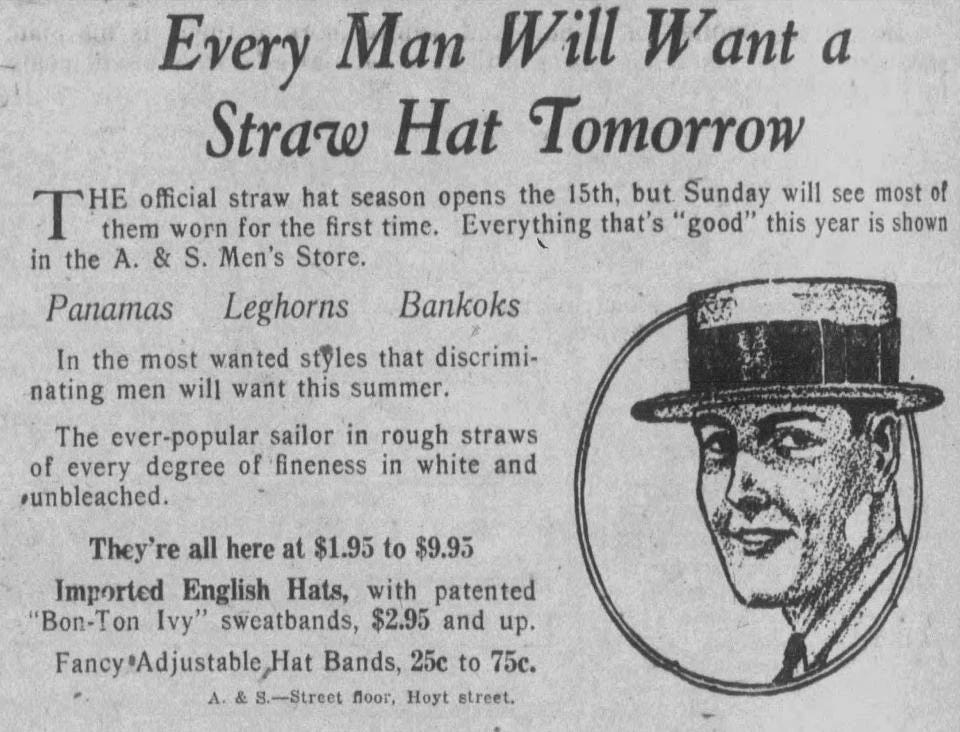
Businessmen were literally up in arms (and by arms, I mean wielding makeshift hat-hooking poles) over when straw boaters should officially be retired for autumn in favor of felt hats. There was much to-do about proper seasonal millinery. As Helen Rowland so brilliantly observed in The Brooklyn Eagle on Tuesday, September 5, 1922:
“The average man’s devotion to his HAT is one of life’s greatest mysteries…something sacred in his life, which he cherishes and protects as passionately as he does his dignity, his honor, and his grandmother’s memory. He will fight for it, quarrel over it and risk his life under a motortruck or a trolley car to salvage its remains, in a wind...When a boy wants to start a fight all he does is to snatch another boy’s hat—and the battle is on.”
Helen went on to note:
“If a man would display half the daring and enthusiasm in pursuing that he does in chasing an old straw hat, life for a girl would be SO much more thrilling!”
Say it louder for the men in the back, Helen.
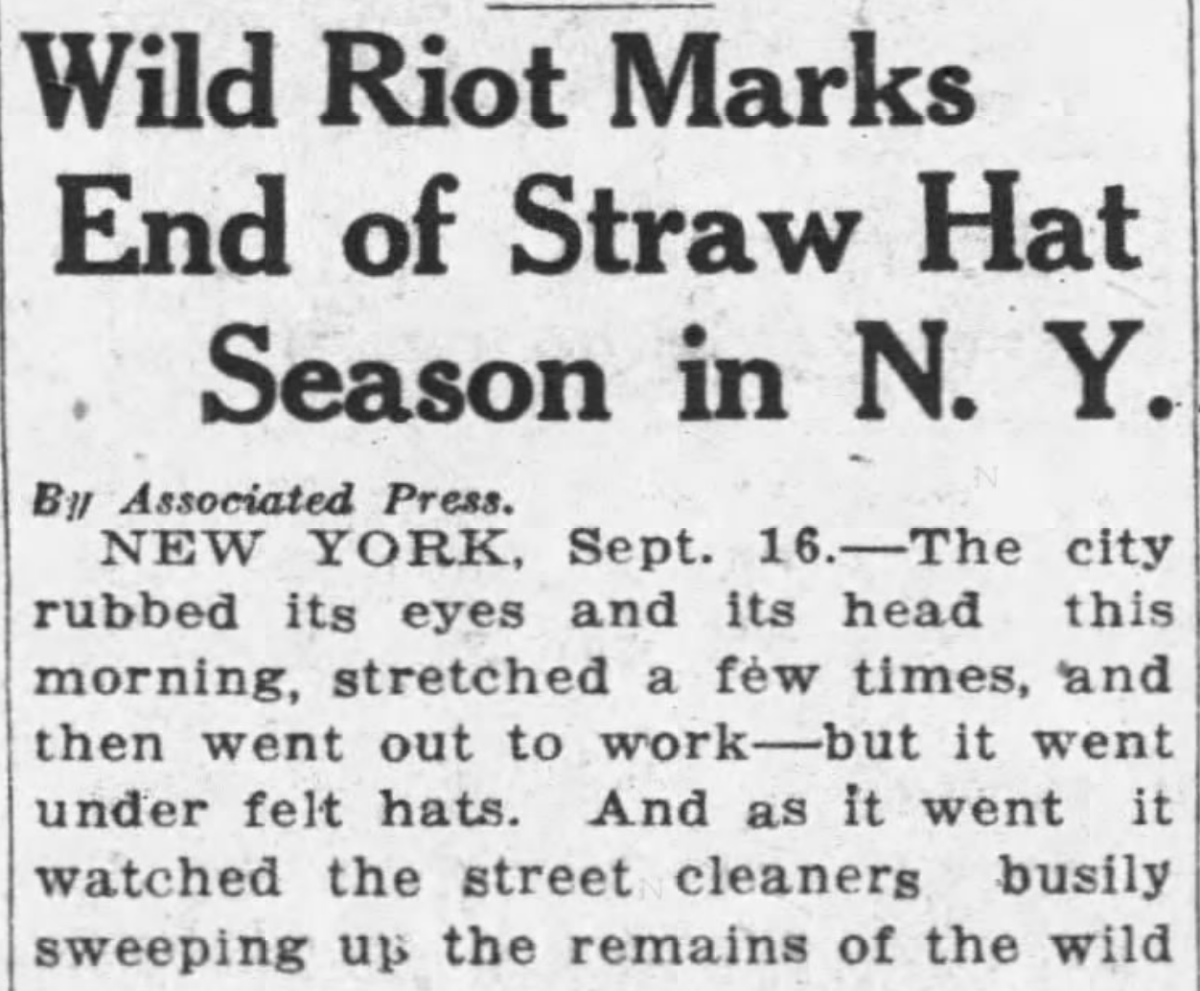
The Straw Hat Riots of 1922 lasted for eight days during which men left and right were getting physically attacked for their hat choice (and they say we ladies are fashion obsessed!). 1922 wasn’t the beginning or the end of the disagreements on the rules around the wearing of straw hats. The Floor Committee of the Pittsburgh Stock Exchange lengthened its season in 1921, deciding that “straw hats may be worn with all the propriety and dignity attached thereto until and including Oct. 1”. This was newsworthy enough that the New York Times wrote about it. Three years after the riots in 1925, President Calvin Coolidge famously publicly ignored the traditional straw-hat discard, after which everyone calmed down a bit. The irony in the whole thing is that, like most trends which come and go, the straw boater hat which once dominated men’s summer fashion, was out of vogue by 1930, following the 1929 stock market crash.
Why should you care? Well, perhaps I can convince you. When we take a step back and look at the bigger picture: clothes have always told a deeper story. Every historical thread, archive, and garment carries the traces of how humans adapted, differentiated themselves, and claimed their space. In the coming weeks at OUTPOST, I’m not going to be authoring another “what-to-wear”. What I will be asking is “why” we wear, unpacking the dig-in-the-archives histories of autumn wardrobe essentials. Think of it as your ultimate survival guide to navigating the season while resting très chic, and loading you up with enough fun-fact fodder to be the most fascinating person at any autumn dinner party. You’ll be historically informed and looking dangerously good.
Let me know where you’d like us to start! I’m currently thinking about cool weather essentials like field jackets, tweed, and heavy-duty work boots. Which, by the way, when can we officially start wearing those? (I’m strictly a “no boots in a July heatwave” kind of gal).
Tell me: what’s the one piece of clothing you would start a riot over? Because if history has taught us anything, it’s that a truly great wardrobe is always something to hang your hat on.
