

The curtains are pulled, the fans are whirring, and the heat is shimmering outside my window. I’m trying to find my inner Grace Kelly, reminding myself that I’m a sophisticated writer rather than someone who just walked outside with immediate regrets. My silk dress is clinging to me like a desperate ex. I’m fairly certain Grace Kelly never had silk stick to her skin.
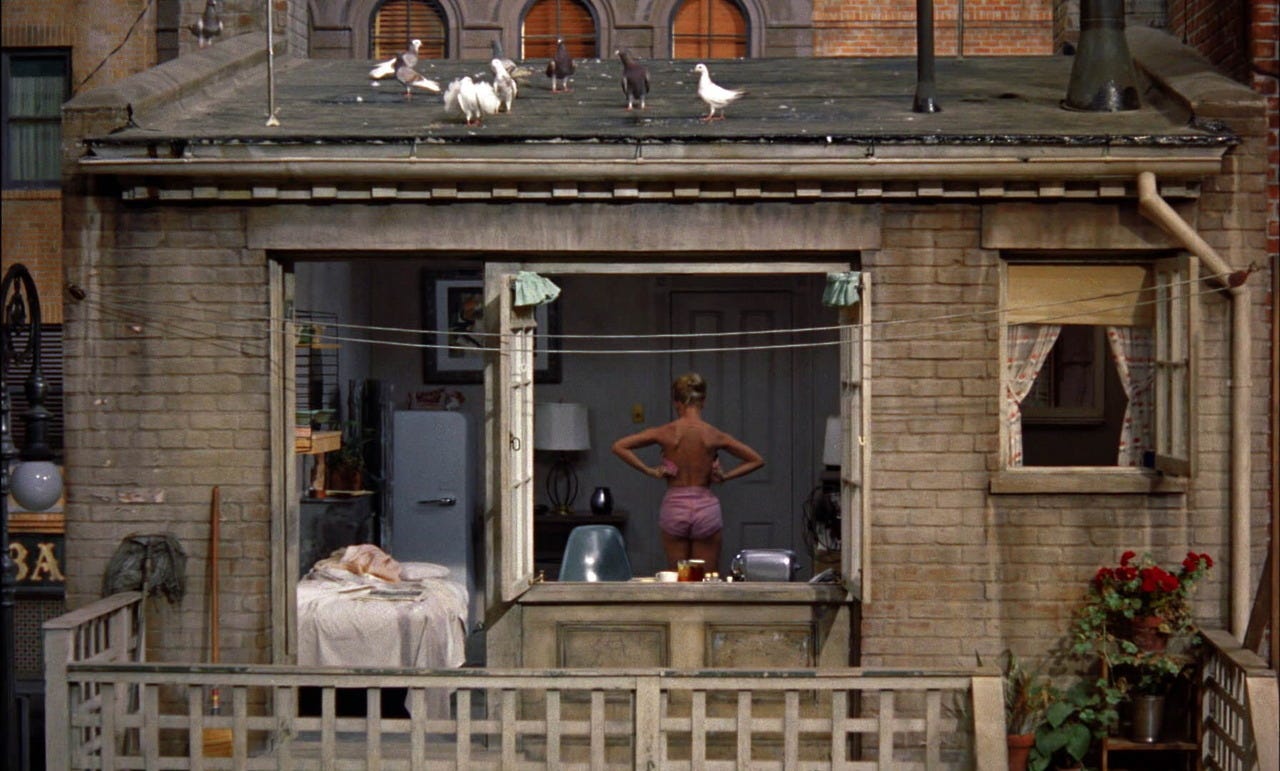
For those familiar with the 1954 Hitchcock classic Rear Window, you remember the actress’ très chic performance as Lisa Fremont. She was a vision in chiffon, a walking advertisement for how to be glamorous even when you’re melting in a New York City heat wave, but during movie nights with my grandmother growing up, I was always far-more fixated on the woman Jimmy Stewart’s character, L.B. Jeffries, called “Miss Torso.” There she was, a ballet dancer pirouetting through her heat-dazed apartment like she was starring in her own private musical, completely unconcerned by the fact that the entire building was watching. I think she had it more figured out than Kelly’s character; she was certainly having more fun.
In Rear Window, the heat is a character with a grudge. Jimmy Stewart’s character, L.B. Jeffries, sidelined by a broken leg in a cast, turns his apartment into a command center for the best show in town: his neighbors. He spends his days with binoculars pressed to his eyes, picking through the lives of the people just across the courtyard. He doesn’t know any of their names, so he instead makes them into characters, giving each a nickname—the songwriter, the newlyweds, Miss Lonelyhearts, the salesman, and my favorite, “Miss Torso”. While he’s trapped in his apartment recovering, he thinks he’s just watching all these people near him like a movie to pass the time.
It’s a tempting way to live, treating life like a flick you’re merely observing, but we’re all guilty of building our own little projection booths. We spend so much energy curating our private spaces and public personas, putting every hair in place, forgetting that the best part of the show isn’t the decor—it’s the unscripted, window-flung-open reality of city life. Or, at least, that’s how it works in the movies. In the window-shuttered reality of Paris, however, the script changes a bit. Hitchcock couldn’t have set Rear Window in Paris, because here, when the heat rises, those volets slam closed faster than a camera shutter. Secrets stay sealed inside, and the city pulls inward in what can only be described as a cavelike hush. The sun bakes those Hausmannian stone exteriors until the entire city feels like it’s holding its breath, waiting for a breeze that isn’t coming.
New York, on the other hand, can’t keep a window closed to save her life. The city throws itself open with a fevered energy when the heat hits. The clack-hiss of window units melts into the sirens shredding the smog and the subway rumbling through your floorboards. It’s total sensory overload, but oh, doesn’t it make you feel like you’re starring in your own movie? Fire escapes turn into stages. We’re out there draped over the iron railings like cast-off laundry, our lives spilling out into the streets in full display. It’s the first urban reality show, and the heat doesn’t just make us sticky—it makes us look.
In cities like these, we are all normally under a silent, voyeuristic contract. We agree to look, but never to stare; to see, but never to acknowledge. We categorize the neighbors à la Jeffries with a single glance: there’s the hedge-fund shark, here’s the tortured downtown artist, and let’s not forget the girl who tried just a little too hard at brunch. We give them nicknames, turn them into characters in our day, and convince ourselves we’re just the audience. It keeps everything at a very comfortable, very curated arm’s length. However, we’re not just the critics, we’re also the actors.
We’re busy playing the role of “The Perfect Parisian” or “The Untouchable New Yorker” and we forget we’re as stifled as the facades themselves. We aren’t being sophisticated; like those Haussmannian buildings, we don’t breathe and we just bake. It reminds me of the moment Lisa admits to Jeffries, “I wish I was creative… I wish I could do the things you do.” Even in head-to-toe couture, she felt confined in her perfection, desperate for a little reality.
Heat is one heck of a truth serum. When the mercury hits the ceiling, the city’s inhibitions finally drop, and the carefully curated calm starts to curdle. In a city as crowded as Paris, you can try to keep your character arc tight and your buttons fastened up to your chin, but sooner or later, the heat is going to strip you down to the person you are once the credits roll. Suddenly, like the tenants of Jeffries’ courtyard, we are all on full display (and rapidly shedding layers). Heat has a way of making everyone a little sexier, a little sweatier, and just a little bit more liable to lose their minds. The “I’m too busy to notice you” mask finally slips. Your poise? It’s running in rivulets down your spine. That “je ne sais quoi” you’ve spent all year projecting? It just evaporated on a steamy street corner. Collars are unbuttoned, makeup is melted, and the usual rules of city decorum simply liquify. Why stare at your phone when you can share a “can you believe this?” eye-roll—or a lingering, heat-drunk look—with the person next to you?
On the street, you might be able to keep up the devil may care act grâce à your sunglasses and your stride. On the metro, however, bon chance when your shoulder is practically adhered to the person next to you. You can’t look away because there’s nowhere else to look, and you can’t look at your phone because your screen is covered in the same condensation as your forehead. Look around and you’ll see the same story playing out on every face. There’s the man in the sharp blazer who has long since abandoned his dignity, his collar loosened, his eyes fixed on the newspaper as if it’s a ransom note. There’s the girl with the vintage silk scarf that was two stops ago, a chic accessory, but now seems to be clinging to her neck like a life-raft. We’re all voyeurs of each other, too drained to even pretend we’re not suffering. We ride out the heat wave like a slow-burn thriller, waiting for the plot to thicken. It isn’t a rom-com, and it’s not film noir, but it is the most honest this city ever gets. We’re all just trying to avoid melting into a pile of accessories and existential dread before the sun sets.
When you’re standing on a metro platform, feeling like a fondue, you realize the best view in the city isn’t the one you get from behind a camera; it’s the one where you finally stop rehearsing and just start being. I’ll share a secret—that’s the only show in town worth watching anyways.
Frankly, trying to stay perfectly temperature-controlled is a losing game. In this fever dream of a summer, I’ve developed a real fondness for the side of me (and my neighbors) that’s a little undone, a little unscripted, and entirely honest. Maybe we can all take a note from Miss Torso: style is less about holding a perfect silhouette against the heat and much more about being the fullest version of yourself with no regard to who is (or isn’t) watching. She just had the nerve to keep moving and not care how it looked.
Yet, as I step out to another hair-dryer blast of hot air on the pavement, my grandmother’s words are in the back of my mind: ladies never sweat; they glow.
